Wednesday, January 23, 2013

Sundial: TEMPUS FUGIT AUGEBITUR SCIENTIA

I was attracted to this sundial because of the DNA double helix that decorates it. The sundial is located in Redu, Belgium. As you can see the sundial is dated 2001 and bears the name JJ Baron (Jean-Jacques Baron). The image is from Wikimedia Commons:


Here is a close-up of the DNA double helix:


The DNA double helix as a visible sign of science complements the Latin motto's optimistic invocation of science:

TEMPUS FUGIT    AUGEBITUR SCIENTIA

Time flies.    Knowledge will increase.

The tempus fugit motto is commonly found on sundials, but the augebitur scientia motto is not common (although Gatty does cite an example: "On the house once occupied by Cuvier at the Jardin des Plantes, Paris"). The words come from the Bible, Daniel 12:4, but the textual tradition here is very tangled. The Catholic Vulgate reads plurimi pertransibunt, et multiplex erit scientia while the Latin version of Tremellius and Junius reads percurrent multi et augebitur cognitio.

We owe the mixed augebitur scientia to the title page of Francis Bacon's Instauratio Magna of 1620 which reads: Multi pertransibunt et augebitur scientia, "Many shall pass through, and knowledge shall increase," with an image of two ships sailing on the ocean, setting out beyond the Pillars of Hercules.


Jean-Jacques Baron, the creator of this sundial, has elegantly substituted the standard tempus fugit phrase for the first part of the motto to create something new, very appropriate for a sundial and very appropriate for science too, as symbolized the DNA double helix. I suspect Francis Bacon would approve!


Latin Proverbs and Fables Round-Up: January 23

Here is a round-up of today's proverbs and fables - and for previous posts, check out the Bestiaria Latina Blog archives. In addition to a free PDF copy of Brevissima: 1001 Tiny Latin Poems, you can also get a free PDF copy of Mille Fabulae et Una: 1001 Aesop's Fables in Latin. If you prefer the heft of a book in your hand, you can get the books in printed form from Lulu.com.

HODIE (Roman Calendar): ante diem decimum Kalendas Februarias.

MYTHS and LEGENDS: The art image for today's legend shows Neoptolemus and Priam; you can also see the legends for the current week listed together here.


TODAY'S MOTTOES and PROVERBS:

3-WORD MOTTOES: Today's 3-word motto is Ratio mihi sufficit (English: My powers of reason suffice me).

3-WORD PROVERBS: Today's 3-word proverb is Tempus omnia sanat (English: Time heals all things).

RHYMING PROVERBS: Today's proverb with rhyme is: Laeta seges parvis ubertim crescit in arvis (English: Happy is the crop that grows abundantly in little fields).

VULGATE VERSES: Today's verse is Radix omnium malorum est cupiditas (I Tim. 6:10). For a translation, check out the polyglot Bible, in English, Hebrew, Latin and Greek, at the Sacred Texts Archive online.

ELIZABETHAN PROVERBS: Here is today's proverb commentary, this time by Taverner: Ne Hercules quidem contra duos: Not Hercules against two, that is to saye: Though a man never so muche excelleth other in strengthe, yet it will be hard for him to matche two at ones. And one man may lawfully give place to a multitude.

BREVISSIMA: The distich poster for today is Hominis Crimina. Click here for a full-sized view; the poem has a vocabulary list and an English translation, too.


And here is today's proverbial lolcat:


TODAY'S FABLES AND SONGS:

FABULAE FACILES: The fable from the Fabulae Faciles widget is Canis Vetulus et Magister, the story of the old dog and his ungrateful master (this fable has a vocabulary list).

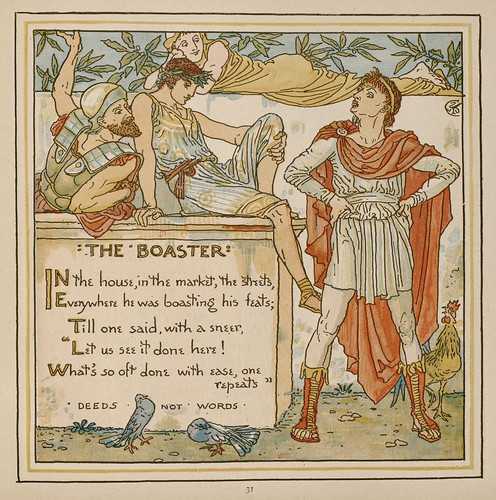
MILLE FABULAE: The fable from the Mille Fabulae et Una widget is Iactator in Patriam Reversus, the story of the boasting athlete.

Hic Rhodus! Hic salta!


Tuesday, January 22, 2013

Sundial: DIES NOSTRI QUASI UMBRA

I chose to write about this sundial because I was looking for another one that has zodiac images, and of course I was delighted to find out that this is a sundial in Poland! I cannot remember actually seeing this sundial when I spent a summer in Kraków, but I certainly visited the Mariacki Church, a beautiful building which is on the city's main square. The sundial was installed in 1954 and is the work of Tadeusz Przypkowski, whose sundials can be seen in many other European cities, as well as at the Royal Observatory in Greenwich!

The Latin motto is from the Bible, 1 Chronicles 29:

Dies nostri quasi umbra super terram et nulla est mora.
Our days on the earth are as a shadow, and there is none abiding.

What an apt motto for a sundial where the shadow moves ever onward without delay!

I found this image at Wikimedia Commons (thanks to Rj1979), and I also found a wonderful photo gallery, including historical photographs from the time of the sundial's installation, at the Gnomonika website.

Here is the sundial, and the zodiac symbols can be seen up and down to the left and the right; click here for a larger image that shows the zodiac signs in detail.


In the upper left, there is also this elegant depiction of the name MARYA (Mary) surrounded by twelve stars, an allusion to the opening words of Revelation 12: Et signum magnum apparuit in caelo: mulier amicta sole, et luna sub pedibus eius, et in capite eius corona stellarum duodecim, "And there appeared a great wonder in heaven: a woman clothed with the sun, and the moon under her feet, and upon her head a crown of twelve stars."


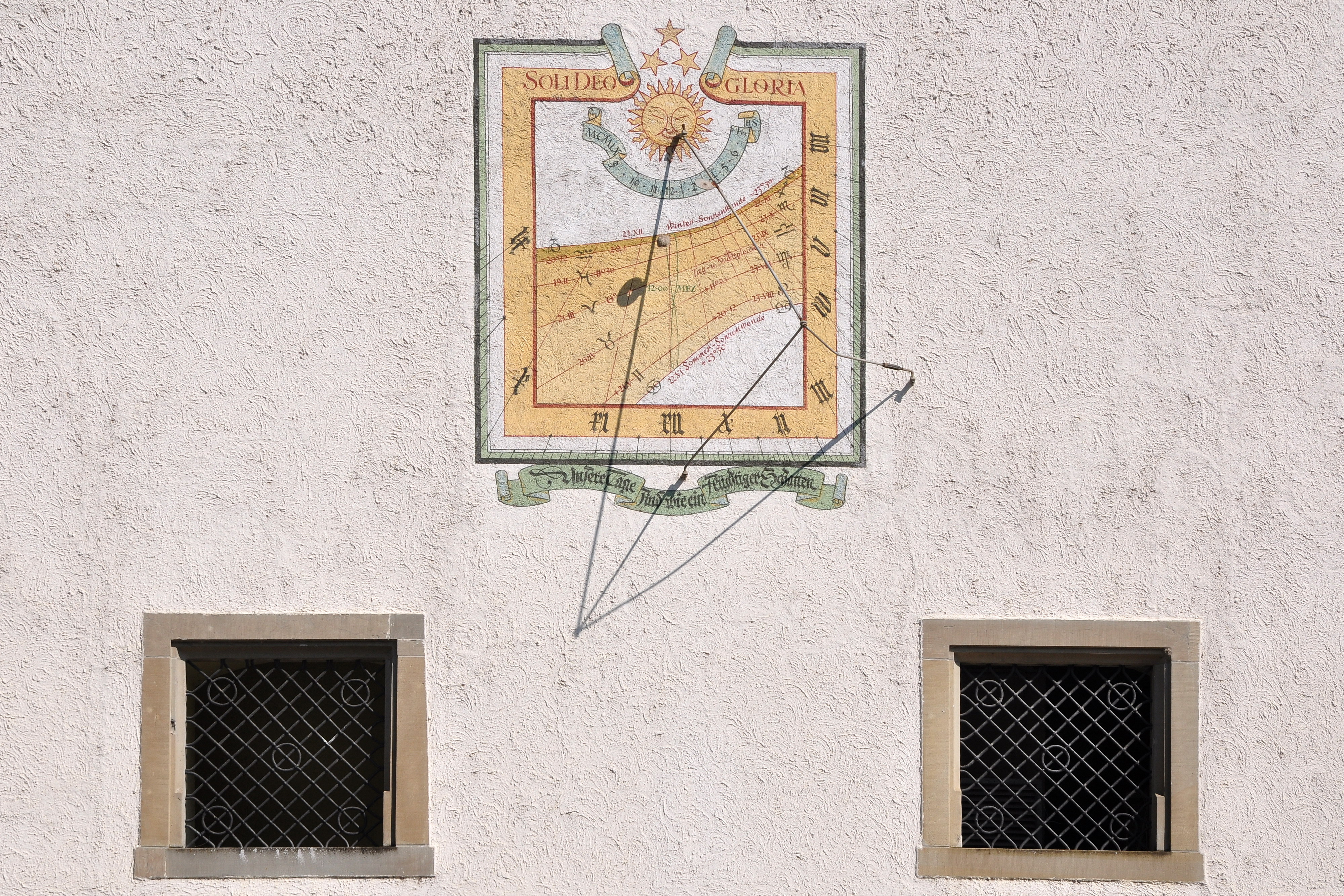
Sundial: SOLI DEO GLORIA

I found this lovely sundial at Wikimedia Commons, thanks to Roland ZH. It is at the Reformierte Kirche in Eglisau (not far from Zurich) in Switzerland.


The Latin motto is especially elegant, perfect for a sun dial:

SOLI DEO GLORIA

Here is a more detailed view:


The Latin words mean "(To) God Alone (is the) Glory." The Latin phrase is of great importance in the history of Christianity; you can learn more about that in this Wikipedia article: Soli Deo Gloria.

The word for "alone" in Latin here is soli, which is the dative form of the adjective solus. This creates a wonderful pun on the word for sun, which is sol in Latin, soli in the dative. So, in addition to meaning "To God Alone is the Glory," the Latin phrase also means "To God, the Sun, is the Glory."

For another sundial with this same Latin motto, see this beautiful image at the British Museum: 19th-century ivory diptych dial (see the motto on the lower dial). See also this diptych dial at the Royal Museums Greenwich.


Meanwhile, this Swiss sundial has a German inscription on a banner which I cannot read; if anybody can help me with this, that would be super! You can see a more detailed view here.


Monday, January 21, 2013

Latin Proverbs and Fables Round-Up: January 21

Here is a round-up of today's proverbs and fables - and for previous posts, check out the Bestiaria Latina Blog archives. If you have not downloaded a free PDF copy of Brevissima: 1001 Tiny Latin Poems, it's ready and waiting! Meanwhile, I'm slowly but surely adding poster images and English translations over at the Brevissima blog.

HODIE (Roman Calendar): ante diem duodecimum Kalendas Februarias.

MYTHS and LEGENDS: The art image for today's legend shows Arion; you can also see the legends for the current week listed together here.


TODAY'S MOTTOES and PROVERBS:

TINY PROVERBS: Today's tiny proverb is: Scientia potentia (English: Knowledge is power).

3-WORD MOTTOES: Today's 3-word verb-less motto is Cito, non temere (English: Quickly, not rashly).

ANIMAL PROVERBS: Today's animal proverb is Leo a leporibus insultatur mortuus (English: A lion, after he's dead, is mocked by the rabbits).

POLYDORUS: Today's proverb from Polydorus is: Qui ipse sibi sapiens prodesse nequit, nequicquam sapit (English: The wise man who does not know how to help himself is wise in vain).

PROPER NAME PROVERBS: Today's proper name proverb from Erasmus is Phormionis torus (English: The bed of Phormio; from Adagia 2.9.66 - Phormio was a vigorous general who loved the military life and slept on the ground with this men, which is to say, without a bed at all).

GREEK PROVERBS: Today's proverb is Ἀνδρὶ σοφῷ πᾶσα γῆ βατή (English: For the wise man, the whole world is walkable).

BREVISSIMA: The distich poster for today is Nocitura. Click here for a full-sized view; the poem has a vocabulary list and an English translation, too.


And here is today's proverbial lolcat:


TODAY'S FABLES AND SONGS:

MILLE FABULAE: The fable from the Mille Fabulae et Una widget is Satyrus et Viator, the story of the satyr and his guest.

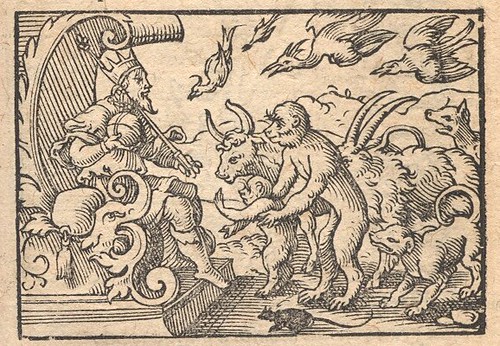
FABULAE FACILES: The fable from the Fabulae Faciles widget is Simia et Catuli Eius, the story about the monkey mother and the animal beauty pageant (this fable has a vocabulary list).

Simia et Iuppiter - Osius


Saturday, January 19, 2013

Sundial: VOLAT IRREVOCABILIS · ULTIMA LATET

This sundial is located in Meran, a city in the South Tyrol (Alto Adige in Italian), which is an autonomous province of northern Italy. At the top of the sundial there is an inscription that reads: A·E·I·O·U, which stands for Austriae Est Imperare Orbi Universo, It is for Austria to rule the whole world (for other Latin interpretations of the acronym, see this Wikipedia article: AEIOU).

Below the sundial is an inscription that reads:

AT IRREVOCABILIS · ULTIMA LATET

Clearly, the first word in the lower left-hand corner has been painted over so that only the last two letters are visible. The full reading should be:

VOLAT IRREVOCABILIS · ULTIMA LATET

The interpunct between the words irrevocabilis and ultima shows that there are two declarative statements here, not just one, with the implied noun hora (hour, time) as the subject of both:

(the hour) flies, not to be called back · (the) final (hour) is hidden

Without the verb volat, the motto simply does not make sense because the adjective "not to be called back" does not fit with hiding. What we have here are two different Latin cliches about time. On the one hand, time is something that flies, something that runs away and will not come back to you no matter how desperately you might call (hora irrevocabilis). Meanwhile, as the present is slipping away irrevocably into the past, the future is unknown, something that is hidden from our knowledge (latet).

Moreover, just above the motto there is a skull together with an hourglass, again reinforcing the two-part interpretation of the motto: the hourglass with sand running through it shows the movement of time (volat irrevocabilis), while the skull is a "memento mori" of our final hour which is certain to come but which is hidden until it does arrive (ultima latet).

Note that there has been an erasure in the upper right-hand corner also, but it is only a decorative element that has been covered over, not part of the inscription itself. Still, the symmetry of the top line shows clearly that a decorative element is missing in the upper right-hand corner, just as there are letters missing in the lower left-hand corner.

So, given the clear evidence for a reading of VOLAT, I am very surprised not to find this interpretation provided somewhere online. Instead, I see repeated on many webpages the incorrect and incomplete transcription with AT, which is then accompanied by a nonsensical English translation that results from the incorrect transcription. Presumably the main source for this repeated error is the Wikimedia webpage which I have used for the source of this image; it features the incorrect transcription and this English translation: "But the last [hour] is hidden, not to be recalled."

If anyone has reason to think I am wrong about this, please let me know!

Meanwhile, the entire presentation is quite beautiful, as you can see in the image below. There is a sun with a face beaming down from the left-hand corner, and the signs of the zodiac at the bottom. Lovely!

Update: Thanks very much to ManfredK for alerting me to his photograph of this sundial at Wikimedia:


ManfredK's high-resolution image allows you to see the detail for the sun, and also the hourglass and skull:


Here is the the image I had originally worked from at Wikimedia, contributed by Alex1011:


(see also the excellent photos
by Michel Lalos here: Cadrans solaires d'Italie,
and by Alessio here: Alefoto.it)