Tuesday, October 5, 2010

Myths and Legends: Alcestis

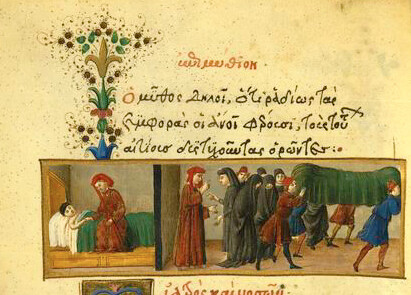
Alcestis Takes the Place of Admetus. To find out more about Alcestis, see this Wikipedia article: link; for information about the image: image source.

As famously told in the play by Euripides, Alcestis was married to King Admetus. The gods had given Admetus a special gift: if someone would agree to go the underworld in his place, he would not have die. Yet Admetus can find no one who will take his place... except for Alcestis, who agrees to go to Hades. You see her being carried off here - luckily, though, Heracles will come to the rescue and return Alcestis to the land of the living.

You can also find more myths and legends for the week of September 30 - October 6 here. For more information and links to the actual javascript code, see the Myths & Legends Widget Reference Page.

Monday, October 4, 2010

Myths & Legends: November 4-10


For more information and links to the actual javascript code, see the Myths & Legends Reference Page.

Briseis. To find out more about Briseis, see this Wikipedia article: link; for information about the image: image source. There's also a post here.


Heracles and Eurystheus. To find out more about the labors of Heracles, see this Wikipedia article: link; for information about the image: image source. There's also a post here.


Hippolytus. To find out more about the tragic story of Hippolytus, see this Wikipedia article: link; for information about the image: image source.


The Origin of the Milky Way. To find out more about Heracles and the origin of the Milky Way, see this Wikipedia article: link; for information about the image: image source. There's also a post here.


Amazons in Battle. To find out more about the women warriors called Amazons, see this Wikipedia article: link; for information about the image: image source.


Heracles and the Centaur Nessus. To find out more about Nessus and the death of Heracles, see this Wikipedia article: link; for information about the image: image source. There's also a post here.


The Sacrifice of Iphigenia. To find out more about Iphigenia, the daughter of Agamemnon, see this Wikipedia article: link; for information about the image: image source.


Round-Up: October 4

Here is a round-up of today's blog posts - and for previous posts, check out the Bestiaria Latina Blog archives. You can keep up with the latest posts by using the RSS feed, or you might prefer to subscribe by email. I'm Twittering again now at Aesopus and AesopusEnglish.

SPECIAL NOTE: I posted a comment at Mary Beard's blog post about Google Translate, singing the praises of NoDictionaries.com. If any of you have been seduced by the allure of Google Translate, take a look at NoDictionaries.com instead - it accomplishes a similar task but is so much more useful! Here's my comment at Mary Beard's blog.

HODIE: ante diem quartum Nonas Octobres (and yes, you can have your own Roman Google Calendar).

VERBUM HODIERNUM: Today's word is NUNC - read a brief essay about the word at the Verbosum blog. Here's one of the sayings you can find in the essay: Vetera quae nunc sunt fuerunt olim nova, "The things which are old now were once new." (As in the saying, "Technology is anything invented since you were born" - a saying I like to use with people who heap scorn on things like the Internet but love printed books - as if printing a book were not technology!)

MILLE FABULAE: New materials at the blog include lots of new illustrated fables along with some new slideshows, including a marvelous 17th-century Aesopic Dutch emblem book that I stumbled upon at Internet Archive. This is also where you can download your free PDF copy of the Mille Fabulae et Una book.

FABULAE FACILES: The new easy-to-read fable is Pisces, Magni et Minuti - this is one of those "small is beautiful" fables which I like so much!

PODCASTS: Today's Latin audio fable is Serpens et Vespa, a fable about a cure that is worse than the disease!

ENGLISH AESOP: Today's English fables are from Sir Roger L'Estrange, Wright's verse translation of La Fontaine and the limericks that accompany Walter Crane's illustrated Aesop.

TODAY'S MOTTOES & PROVERBS: Widgets available at SchoolhouseWidgets.com.

Tiny Proverbs: Today's tiny proverb is: Occasionem cognosce (English: Know the moment - or, as we say in English, timing is everything!).

3-Word Mottoes Verb-less: Today's 3-word verb-less motto is Mens et manus. (English: Mind and hands - a great motto about using all your powers, mental and physical).

Latin Animal Proverb: Today's animal proverb is Cattus de caseo tarde depellitur eso (English: It is too late to drive the cat away from the cheese once it's already been eaten - plus the Latin version rhymes!).

Proverbs of Polydorus: Today's proverb from Polydorus is: Spiritus ubi vult spirat (English: The spirit blows where it will).

Proper Name Proverb from Erasmus: Today's proper name proverb from Erasmus is Spartam nactus es, hanc orna (English: You have Sparta as your inheritance; adorn her; from Adagia 2.5.1; These are words that Agamemnon speaks to his brother Menelaus in Euripides's play Telephus - the idea is that it is best to accept whatever is your lot and make the most of it).

Greek Proverb of the Day: Today's proverb is Ἐχθρῶν ἄδωρα δῶρα, κουκ ὀνήσιμα (English: The gifts of enemies are not gifts and they are not profitable - literally, the gifts of enemies are "un-gifts," ἄδωρα).

Today's image is from the beautiful Medici Aesop, illustrating the fable of the doctor and his dead patient: 899. Medicus et Mortuus. Medicus aegrotum curabat. Cum hic autem obiisset, ille ad efferentes dicebat, “Vir iste, si vino abstinuisset clysteribusque usus esset, profecto minime interiisset.” Tum quidam ex iis, qui aderant, protinus respondens, “Haud nunc,” ait, “O praeclare, oportebat ista te dicere cum iuvare nihil possunt, sed tunc aegrotum de his admonere debebas, cum uti poterat.” (source)

Medicus et Mortuus

Sunday, October 3, 2010

Myths and Legends: Hercules and Antaeus

Hercules and Antaeus. To find out more about the giant Antaeus, see this Wikipedia article: link; for information about the image: image source.

This is one of my favorite of Hercules' exploits - Antaeus had this special power that, so long as he was in contact with the earth (who was his own mother, Gaia), he was enormously strong. Hercules finally figured that out and lifted Antaeus off the ground; thus deprived of his strength, Antaeus was no match for the mighty Hercules. This dramatic painting is by the Renaissance artist Antonio del Pollaiolo

You can also find more myths and legends for the week of September 30 - October 6 here. For more information and links to the actual javascript code, see the Myths & Legends Widget Reference Page.

Saturday, October 2, 2010

Round-Up: October 2

Here is a round-up of today's blog posts - and for previous posts, check out the Bestiaria Latina Blog archives. You can keep up with the latest posts by using the RSS feed, or you might prefer to subscribe by email. I'm Twittering again now at Aesopus and AesopusEnglish.

HODIE: ante diem sextum Nonas Octobres (and yes, you can have your own Roman Google Calendar).

VERBUM HODIERNUM: Today's word is RELINQUO - read a brief essay about the word at the Verbosum blog. Here's one of the sayings you can find in the essay: Assueta relinquere durum est., "it is hard to give up familiar things."

MILLE FABULAE: New materials at the blog include lots of new illustration slideshows including a great set of images from Aunt Louisa's Oft Told Tales. This is also where you can download your free PDF copy of the Mille Fabulae et Una book.

FABULAE FACILES: The new easy-to-read fable is Formicae et Cicada, the famous story of the ants and the grasshopper.

ENGLISH AESOP: Today's English fables are from Sir Roger L'Estrange, the limericks in Walter Crane's Aesop, Pratt's Aesop for children and Wright's translation of La Fontaine.

TODAY'S MOTTOES & PROVERBS: Widgets available at SchoolhouseWidgets.com.

Tiny Mottoes: Today's tiny motto is: Amo pacem (English: I love peace).

3-Word Proverbs Verb-less: Today's 3-word verb-less proverb is Lupus in fabula (English: Speak of the wolf - or, as we would say in English, speak of the devil!)

Audio Latin Proverb: Today's audio Latin proverb is Cibus non qui plurimus, sed qui suavissimus (English: Food: not the largest quantity but the most pleasant). To read a brief essay about this proverb and to listen to the audio, visit the Latin Via Proverbs blog.

Maxims of Publilius Syrus: Today's proverb from Publilius Syrus is: Maximo periclo custoditur, quod multis placet (English: Something that many people want is hardest to protect).

Animal Proverb from Erasmus: Today's animal proverb from Erasmus is Echinus partum differt (English: The hedgehog delays giving birth; from Adagia 2.4.82 - the idea being that things actually get, worse, not better, the longer she puts it off, as the little hedgehogs get pricklier and pricklier!).

Today's image is from Aunt Louisa's Oft Told Tales as mentioned above - as you can see, it is the famous story of the city mouse and the country mouse! The mice, as you can see, are BIG. :-)

Friday, October 1, 2010

Myths and Legends: The Death of Niobe's Children

The Death of Niobe's Children. To find out more about the boastful Niobe, see this Wikipedia article: link; for information about the image: image source.

This shows the dramatic scene in which Apollo and his sister Artemis (Diana) shoot down the children of Niobe, all those beautiful boys and girls that Niobe had boasted about. You can read the entire story in Ovid's Metamorphoses, Book 6.

You can also find more myths and legends for the week of September 30 - October 6 here. For more information and links to the actual javascript code, see the Myths & Legends Widget Reference Page.