Saturday, June 9, 2012

Latin Without Latin: Ob Amorem

Here's a new Latin Without Latin essay! The previous two essays were Essay #37: Nescio Quid Sit Amor and Essay #38: Iupiter (you can see a complete list of essays here). And here is the new essay:

Essay #39: Ob Amorem

Round-Up: June 9

Here is a round-up of today's proverbs and fables - and for previous posts, check out the Bestiaria Latina Blog archives. On alternating days this summer, I'm posting a separate disticha round-up, too!

HODIE: ante diem quintum Idus Iunias.

MYTHS and LEGENDS: The art image for today's legend shows The Rape of the Sabine Women; you can also see the legends for the current week listed together here.


TODAY'S MOTTOES and PROVERBS:

3-WORD MOTTOES: Today's 3-word motto is Curae cedit fatum (English: Fate yields to carefulness - or, you might say, diligence is a remedy for bad luck!).

3-WORD PROVERBS: Today's 3-word proverb is Oderint, dum metuant (English: Let them hate, so long as they fear - words from a Roman tragedy as quoted by the Roman emperor Caligula).

RHYMING PROVERBS: Today's proverb with rhyme is: Qui bona vina bibunt, etiam bona carmina scribunt (English: Those who drink good wines also write good poems).

VULGATE VERSES: Today's verse is Pulvis es, et in pulverem reverteris (Genesis 3:19). For a translation, check out the polyglot Bible, in English, Hebrew, Latin and Greek, at the Sacred Texts Archive online.

ELIZABETHAN PROVERBS: Here is today's proverb commentary, this time by Taverner: Iucunda vicissitudo rerum: Chaunge of thinges is pleasaunt. Where shift of thinges is not, mans minde anone shall ware werie and dull. For assuredly such is the nature of things, so great lothsomnes, there is of mans appetite, that nothinge can be so swet but shal be abhorred, if it be any longe while used. Nothing is so galaunt, so excellent, that can longe content the minde.

TODAY'S FABLES and STORIES:

ANECDOTE OF THE DAY: Today's anecdote is Leo Nemeae, the story of Hercules' first labor.

FABULAE FACILES WIDGET: The fable from the Fabulae Faciles widget is Vulpes et Uva, the story of the "sour" grapes (this fable has a vocabulary list).

MILLE FABULAE WIDGET: The fable from the Mille Fabulae et Una widget is Ciconia et Vulpecula, a story about culinary revenge.

AESOP IN ENGLISH VERSE: Today's fable from the English verse widget is Neptune and Pallas, a story of the competition between the two gods for the favor of the city of Athens (Athena won, of course).

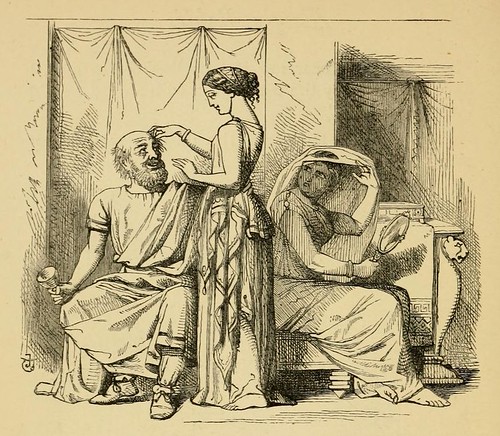
MILLE FABULAE: The "chunk" of Mille Fabulae et Una today is Fable 951, Mulier et Speculum, through Fable 960, Servus Profugiens et Aesopus, including Concubinae Duae, a wonderful story about a man and his two lovers: Senex, cuius caput respersum iam erat canis, habebat concubinas duas, moribus et aetate dissimiles, nam altera iuvencula et lascivior, altera aetate provecta et severior erat. Ut igitur ad harum alteram forte accesserat, ita crines non similes suis dormienti vellebantur. Carpebat enim iuvencula albos, senior vero nigros. Tandem ille calvo capite omnibus risui fuit.

Vir et Uxores Duae

Friday, June 8, 2012

Latin Without Latin: Jupiter

Here's a new Latin Without Latin essay! The previous two essays were Essay #36: Dulcius Nil Puto and Essay #37: Nescio Quid Sit Amor (you can see a complete list of essays here). And here is the new essay:

Essay #38: Iupiter

Distich Round-Up: June 8

The distichs below are all keyed to the vocabulary in the DCC Latin vocabulary list: DCC Latin Vocabulary Distichs. Plus, don't forget to check out the "Latin Without Latin" distich essays - there will be a new one every day this summer.

For vocabulary and additional information about each poem, click on the title.

Nulla Dies Sine Linea
Nulla dies abeat quin linea ducta supersit;
Non decet ignavum praeteriisse diem.

Pecunia Rerum Regina
Unica cunctarum regina Pecunia rerum;
Praecipuum magno pro Iove numen habet.

Fortis
Instanti veniunt subeunda pericula casu:
Rebus in angustis fortia corda patent.

Frustra lingua laborat...
Frustra lingua laborat, si cor non simul orat;
Non clamor, sed amor cantat in aure Dei.

Surge puer vigila...
Surge puer, vigila, canta, lege, disce vel ora,
Sic fac, ut nulla sine fructu transeat hora.

Antiquus gladius....
Antiquus gladius, vetus atque fidelis amicus
Sunt tibi pro muro, cum stas in tempore duro.

Si videas fratres...
Si videas fratres inter se bella gerentes,
Neutri confer opem, sed eorum corrige mentem.

Duc me nec sine me duci...
Duc me, nec sine me duci, Deus optime, per me,
Nam duce me pereo, te duce fausta gero.

Tempus adhuc veniet...
Tempus adhuc veniet, quo dives, qui modo gaudet,
Assidue flebit, dum pauper grata videbit.

Aures fert paries...
Aures fert paries, oculos nemus: ergo cavere
Debet, qui loquitur, ne possint verba nocere.


Thursday, June 7, 2012

Latin Without Latin: Nescio Quid Sit Amor

Here's a new Latin Without Latin essay! The previous two essays were Essay #35 Nox et Amor Vinumque and Essay #36: Dulcius Nil Puto (you can see a complete list of essays here). And here is the new essay:


Round-Up: June 7

Here is a round-up of today's proverbs and fables - and for previous posts, check out the Bestiaria Latina Blog archives. I'm using Google+ a lot these days - highly recommended as a thought-provoking place to hang out online!

HODIE: ante diem septimum Idus Iunias.

MYTHS and LEGENDS: The art image for today's legend shows Diogenes Casting away his Cup; you can also see the legends for the current week listed together here.


TODAY'S MOTTOES and PROVERBS:

TINY PROVERBS: Today's tiny proverb is: Ferte fortiter (English: Bear up bravely).

3-WORD MOTTOES: Today's 3-word verb-less motto is Deus pastor meus (English: God is my shepherd).

ANIMAL PROVERBS: Today's animal proverb is Intereunt feles, celebrant convivia mures (English: The cats die; the mice hold a party).

POLYDORUS: Today's proverb from Polydorus is: Omnia tempus habent (English: All things have their time).

PROPER NAME PROVERBS: Today's proper name proverb from Erasmus is Lynceo perspicacior (English: More clear-sighted than Lynceus; from Adagia 2.1.54 - Lynceus was famous for his eyesight; he supposedly invented mining for metals since he could see the silver and gold under the ground).

GREEK PROVERBS: Today's proverb is Ἀιεὶ τὰ πέρυσι βελτίω (English: Past things are always better).

TODAY'S FABLES and STORIES:

ANECDOTE OF THE DAY: Today's anecdote is Hannibal in Italiam, which includes the famous crossing of the Alps.

FABULAE FACILES WIDGET: The fable from the Fabulae Faciles widget is Formica Transformata, the story of the origin of the ant (this fable has a vocabulary list).

MILLE FABULAE: The "chunk" of Mille Fabulae et Una today is Fable 941, Mulier Indomita et Vir Eius, through Fable 950, Puella Superba , including Vidua et Asinus Viridis, a hilarious story about novelty... and how quickly it wears off.

AESOP IN ENGLISH VERSE: Today's fable from the English verse widget is Neither Beast Nor Bird, in other words: a story about a bat.

MILLE FABULAE WIDGET: The fable from the Mille Fabulae et Una widget is Simia et Gemelli Eius, a story about how the monkey treats her twins very differently: Simia, ut ferunt, cum peperit gemellos, alterum diligit, alterum negligit. Erat puerpera cum gemellis atque, cum incidisset terror, vitatura periculum, dilectum prehendit ulnis. Quem, dum praeceps fugitat, collidit petrae atque enecat. Neglectus autem, qui in hirsuto haeserat tergo fugientis, mansit incolumis.

Simia et Gemelli Eius