Friday, September 30, 2011

Round-Up: September 30

Here is a round-up of today's blog posts - and for previous posts, check out the Bestiaria Latina Blog archives. There are notices also at Twitter - look for Aesopus and AesopusEnglish.

HODIE: pridie Kalendas Octobres, the last day of September!

SCALA SAPIENTIAE: Today you can find sayings that go up to Diederich frequency ranking 100 - so the proverbs contain nothing but words found among the 100 most commonly used words in Latin. Here is one of the items in today's list: Non sibi solum, "Not for oneself alone."

ANECDOTE OF THE DAY: Today's anecdote is Aeneas et Lavinia, the story of Aeneas' marriage in Italy.

VERBUM HODIERNUM: Today's NEW word is LUMEN - read a brief essay about the word at the Verbosum blog. Here's one of the sayings you can find in the essay: Scientia lumen vitae, "Knowledge is the light of life."

VERBUM WIDGET: The word from the daily widget is MEUS - which also has a brief essay at the Verbosum blog. Here's one of the sayings you can find in that essay: Quidquid bene dictum est ab ullo, meum est, "Whatever has been well said by another is mine."

FABULAE FACILES: The NEW easy-to-read fable is Mustela et Lima, the story of a fierce and foolish weasel.

FABULAE FACILES WIDGET: The fable from the Fabulae Faciles widget is Oves Timidae et Pastor, the story of a shepherd who wanted his sheep to be bold and brave.

MILLE FABULAE: ILLUSTRATIONS: The NEW fables with images are Muscae et Equus, the story of why the flies leave the fat horse alone, and Iuvenis et Vir Senex, the story of a reckless young man and an insightful old man.

MILLE FABULAE: ILLUSTRATIONS: The fable from the Mille Fabulae et Una widget is Lupus Esuriens et Nutrix, the famous story of a literal-minded wolf.

GOOGLE BOOKS: Today's Google Books are Buxtorf's Florilegium Hebraicum and Stassart's Fables .

TODAY'S MOTTOES & PROVERBS: Widgets available at Schoolhouse Widgets.

Tiny Proverbs: Today's tiny proverb is: Stentore clamosior (English: Louder than Stentor - which is where we get the English word "stentorian").

3-Word Mottoes Verb-less: Today's 3-word verb-less motto is Per ardua stabilis (English: Standing steady in difficulties).

Latin Animal Proverb: Today's animal proverb is Porcellum alens, porcum habebis (English: Raising a piglet, you'll have a pig).

Proverbs of Polydorus: Today's proverb from Polydorus is: Spiritus ubi vult spirat (English: The spirit blows where it will).

Proper Name Proverb from Erasmus: Today's proper name proverb from Erasmus is Lemnia manu (English: By a Lemnian hand; from Adagia 2.10.44 - this refers to any especially wicked crime, referring to the women of Lemnos who murdered all the men of the island in a fit of jealous rage).

Greek Proverb of the Day: Today's proverb is Ἀφροδίτῃ ὗν τέθυκεν (English: He sacrificed a pig to Aphrodite... which is like mixing apples and oranges: Aphrodite did not like pigs, especially since it was a wild pig who killed her lover Adonis).

For an image today, I wanted to call your attention to the wonderful new post at the BibliOdyssey blog, The Temple of the Muses, which is an 18th-century book of mythological illustrations. Here is the fall of Icarus:

Tuesday, September 27, 2011

Round-Up: September 28

Here is a round-up of today's blog posts - and for previous posts, check out the Bestiaria Latina Blog archives. You can keep up with the latest posts by using the RSS feed, or you might prefer to subscribe by email.

HODIE: ante diem quartum Kalendas Octobres.

SCALA SAPIENTIAE: Today you can find sayings that go up to Diederich frequency ranking 94 - so the proverbs contain nothing but words found among the 94 most commonly used words in Latin. Here is one of the items in today's list: Qui sibi malus, nulli bonus, "Someone who is bad to himself is good for no one."

ANECDOTE OF THE DAY: Today's anecdote is Servius Interfectus, the sad story of the death of Servius.

VERBUM HODIERNUM: Today's NEW word is VELOX - read a brief essay about the word at the Verbosum blog. Here's one of the sayings you can find in the essay: Ne velox sis ad irascendum, "Don't be quick to get angry."

VERBUM WIDGET: The word from the daily widget is POPULUS - which also has a brief essay at the Verbosum blog. Here's one of the sayings you can find in that essay: Populus vult decipi, ergo decipiatur, "The public wants to be deceived; therefore, let it be deceived."

FABULAE FACILES: The NEW easy-to-read fable is Hirundo et Corvus, a debate about beauty between the swallow and the crow.

FABULAE FACILES WIDGET: The fable from the Fabulae Faciles widget is Feles, Aquila, et Sus, a story about how the sly cat was able to trick both the eagle and the sow.

MILLE FABULAE: ILLUSTRATIONS: The NEW fables with images are Calvi Duo et Pecten, the paradox of the bald men who found a comb, and Senex et Cani Tincti, the story of the vain old man among the Spartans.

MILLE FABULAE: ILLUSTRATIONS: The fable from the Mille Fabulae et Una widget is Vespertilio, Rubus, et Mergus, a story about why the bat only comes out at night, among other things.

GOOGLE BOOKS: Today's Google Books are Hazlitt's English Proverbs and Proverbial Phrases and Marvin's Curiosities in Proverbs .

TODAY'S MOTTOES & PROVERBS: Widgets available at Schoolhouse Widgets.

Tiny Mottoes: Today's tiny motto is: Deus providebit (English: God will provide).

3-Word Proverbs Verb-less: Today's 3-word verb-less proverb is Fortuna levis dea (English: Luck is a fickle goddess)

Audio Latin Proverb: Today's audio Latin proverb is Multae regum aures atque oculi (English: Many are the ears of kings, and their eyes). To read a brief essay about this proverb and to listen to the audio, visit the Latin Via Proverbs blog.

Maxims of Publilius Syrus: Today's proverb from Publilius Syrus is: Bonus vir nemo est, nisi qui bonus est omnibus (English: No one is good unless he is good to everyone).

Animal Proverb from Erasmus: Today's animal proverb from Erasmus is Echinus partum differt (English: The hedgehog delays giving birth - although this is a big mistake: the baby hedgehogs get pricklier and pricklier the longer the mother waits; from Adagia 2.4.82).

For an image today, here is poor Servius: Hic rex interfectus est scelere filiae Tulliae et Tarquinii Superbi, filii eius regis, cui Servius successerat. Nam ab ipso Tarquinio interfectus est. Tullia in forum properavit, et prima coniugem regem salutavit. Cum domum redıret, aurigam super patris corpus, in via iacens, carpentum agere iussit. (source)

Monday, September 26, 2011

Round-Up: September 26

Here is a round-up of today's blog posts - and for previous posts, check out the Bestiaria Latina Blog archives. I'm using Google+ a lot these days - are there any of you I should look for there?

HODIE: ante diem sextum Kalendas Octobres.

ANECDOTE OF THE DAY: Today's anecdote is Romuli Mors , the mysterious death of Romulus.

VERBUM HODIERNUM: Today's NEW word is MUNDUS - read a brief essay about the word at the Verbosum blog. Here's one of the sayings you can find in the essay: Patria mea totus hic mundus est, "My homeland is this whole world."

VERBUM WIDGET: The word from the daily widget is NULLUS - which also has a brief essay at the Verbosum blog. Here's one of the sayings you can find in that essay: Fortuna nulli plus quam consilium valet, "For no one is luck more powerful than planning."

FABULAE FACILES: The NEW easy-to-read fable is Lupus Monachus, the story of an old wolf learning some new tricks.

FABULAE FACILES WIDGET: The fable from the Fabulae Faciles widget is Vulpes et Mulieres, the story of the fox who accused the women of hypocrisy, and what one of the women said in reply!

MILLE FABULAE: ILLUSTRATIONS: The NEW fables with images are Iactator et Aesopus, a debate between Aesop and a boastful man about what constitutes a true victory, and Iactatores Duo, Atheniensis et Thebanus, a debate about the relative merits of Theseus and Hercules.

MILLE FABULAE: ILLUSTRATIONS: The fable from the Mille Fabulae et Una widget is Leo Irretitus et Vulpes, in which the fox gives the lion some good advice.

GOOGLE BOOKS: Today's Google Books are Prior's Lusus Westmonasteriensis and Lancelot's Epigrammatum Delectus.

TODAY'S MOTTOES & PROVERBS: Widgets available at Schoolhouse Widgets.

3-Word Mottoes: Today's 3-word motto is Luceo, non uro (English: I shine; I do not burn).

3-Word Proverbs: Today's 3-word proverb is Ut ameris, ama (English: In order to be loved, love).

Rhyming Proverbs: Today's proverb with rhyme is: Simia est simia, etiamsi aurea gestet insignia (English: A monkey is a monkey, even if it wears gold medals).

Vulgate Verse: Today's verse is Unus interitus est hominis et iumentorum (Ecc. 3:19). For a translation, check out the polyglot Bible, in English, Hebrew, Latin and Greek, at the Sacred Texts Archive online.

Elizabethan Proverb Commentary: Here is today's proverb commentary, this time by Conybeare: Dictum ac factum: Is a proverbe signifienge all mannes diligence and laboure necessarie to the doynge or bringinge to pass of any thinge. Donatus sayeth Dictum ac factum to be a proverbiall speakinge, betokeninge celeritie and spede yn doinge or dispatchinge of a thinge.

For an image today, here is the wolf-turned-monk: 100. Lupus Monachus. Lupus, in senium deductus, cum non amplius venari posset, sese religioni addixit, sumptoque monachi habitu, cibum ostiatim mendicabat. Reprehensus ab alio lupo, “Quid vis,” inquit, “faciam? Dentes deciderunt, currere non valeo, quare aliter vivere posse diffido.” (source - easy version)

[wolf_reading.gif]

Saturday, September 24, 2011

Round-Up: September 24

Here is a round-up of today's blog posts - and for previous posts, check out the Bestiaria Latina Blog archives. There are notices also at Twitter - look for Aesopus and AesopusEnglish.

HODIE: ante diem octavum Kalendas Octobres.

SCALA SAPIENTIAE: Today you can find sayings that go up to Diederich frequency ranking 87 - so the proverbs contain nothing but words found among the 87 most commonly used words in Latin. Here is one of the items in today's list: Cum dixeris quod vis, audies quod non vis, "When you say what you want, you will hear what you don't want."

ANECDOTE OF THE DAY: Today's anecdote is Tarpeia, the story of Tarpeia from whom the Tarpeian Rock gets its name!

VERBUM HODIERNUM: Today's NEW word is SOLUS - read a brief essay about the word at the Verbosum blog. Here's one of the sayings you can find in the essay: Solus non est quem diligant dii, "He whom the gods love is not alone."

VERBUM WIDGET: The word from the daily widget is PLUS - which also has a brief essay at the Verbosum blog. Here's one of the sayings you can find in that essay: Vincere cor proprium plus est quam vincere mundum, "To conquer one's own mind is greater than conquering the world."

FABULAE FACILES: The NEW easy-to-read fable is Taurus et Culex, a funny little story about a self-important gnat.

FABULAE FACILES WIDGET: The fable from the Fabulae Faciles widget is Ranae Duae et Puteus, the story of two frogs who are looking for a new home.

MILLE FABULAE: ILLUSTRATIONS: The NEW fables with images are Alexander et Lacedaemonii, a story about Alexander claiming to be a god, and Annon et Aves, a hilarious story about an otherwise unknown man named Annon who also decided he would be a god.

MILLE FABULAE: ILLUSTRATIONS: The fable from the Mille Fabulae et Una widget is Asinus Animalia Fugans et Leo, a story about the partnership between the donkey and the lion.

GOOGLE BOOKS: Today's Google Books are Dodd's Epigrammatists and Hieroglyphics of Horapollo Nilous.

TODAY'S MOTTOES & PROVERBS: Widgets available at Schoolhouse Widgets.

Tiny Proverbs: Today's tiny proverb is: Experto credite (English: Trust someone with experience).

3-Word Mottoes Verb-less: Today's 3-word verb-less motto is Virtutis praemium felicitas (English: Happiness is the reward of excellence).

Latin Animal Proverb: Today's animal proverb is Equo currenti non opus calcaribus (English: There's no need to spur a running horse).

Proverbs of Polydorus: Today's proverb from Polydorus is: Hilarem datorem diligit deus (English: God loves someone who gives cheerfully).

Proper Name Proverb from Erasmus: Today's proper name proverb from Erasmus is Stupidior Praxillae Adonide (English: More stupid than the Adonis of Praxilla; from Adagia 2.9.11 - This refers to a poetess Praxilla who wrote a poem about Adonis in which Adonis foolishly said that the most beautiful things in the world were the sun, apples, and pumpkins; including pumpkins in that list made Adonis look so foolish that he became a byword for foolishness).

Greek Proverb of the Day: Today's proverb is Χελώην Πεγάσῳ συγκρίνεις (English: You're comparing a tortoise to Pegasus - like apples and oranges, but this time it's a slow tortoise and the air-borne Pegasus).

For an image today, Here is a Republic Roman coin showing Tarpeia being crushed by the shields of the Sabines: Populi illi, quorum virgines raptae erant, bellum adversus raptores susceperunt. Cum Romae appropinquarent, forte in Tarpeiam virginem inciderunt, quae in arce sacra procurabat. Hanc rogabant, ut viam in arcem monstraret, eique permiserunt ut munus sibi posceret. Illa petiit ut sibi darent quod in sinistris manibus gererent, annulos aureos et armillas significans. At hostes in arcem ab ea perducti scutis Tarpeiam obruerunt; nam et ea in sinistris manibus gerebant. (source)

Wednesday, September 21, 2011

Round-Up: September 21

Here is a round-up of today's blog posts - and for previous posts, check out the Bestiaria Latina Blog archives. You can keep up with the latest posts by using the RSS feed, or you might prefer to subscribe by email.

HODIE: ante diem undecimum Kalendas Octobres.

SCALA SAPIENTIAE: Today you can find sayings that go up to Diederich frequency ranking 81 - so the proverbs contain nothing but words found among the 81 most commonly used words in Latin. Here is one of the items in today's list: Omnes terra sumus, "We all are earth."

ANECDOTE OF THE DAY: Today's anecdote is Lupa et Pastor, the story of the she-wolf who suckled Romulus and Remus.

VERBUM HODIERNUM: Today's NEW word is BELLUM - read a brief essay about the word at the Verbosum blog. Here's one of the sayings you can find in the essay: Habet et bellum suas leges, "Even war has its own laws."

VERBUM WIDGET: The word from the daily widget is DOMINUS - which also has a brief essay at the Verbosum blog. Here's one of the sayings you can find in that essay: Dominus dedit, Dominus abstulit, "The Lord has given; the Lord has taken away."

FABULAE FACILES: The NEW easy-to-read fable is Formica Alata, the story of the foolish ant who wanted to fly.

FABULAE FACILES WIDGET: The fable from the Fabulae Faciles widget is Anguis et Milvus, the story of a greedy kite and an angry snake.

MILLE FABULAE: ILLUSTRATIONS: The NEW fables with images are Zoilus, a witty indictment of the archetypal critic, Zoilus, and Avarus et Leo Aureus, the sad plight of the greedy man and the lion of gold.

MILLE FABULAE: ILLUSTRATIONS: The fable from the Mille Fabulae et Una widget is Leo et Tauri, a fable about the strategy of "divide and conquer."

GOOGLE BOOKS: Today's Google Books are Liburnius' Divini Platonis Gnomologia and Caussin's De Symbolica AEgyptiorum Aapientia .

TODAY'S MOTTOES & PROVERBS: Widgets available at Schoolhouse Widgets.

Tiny Mottoes: Today's tiny motto is: Meliora speranda (English: Better things are to be hoped for).

3-Word Proverbs Verb-less: Today's 3-word verb-less proverb is Nulla salus bello (English: There is no safety in war)

Audio Latin Proverb: Today's audio Latin proverb is Mus satur insipidam diiudicat esse farinam (English: The mouse, when full, considers the flour insipid). To read a brief essay about this proverb and to listen to the audio, visit the Latin Via Proverbs blog.

Maxims of Publilius Syrus: Today's proverb from Publilius Syrus is: Incertus animus dimidium est sapientiae (English: A mind that doubts is halfway to wisdom).

Animal Proverb from Erasmus: Today's animal proverb from Erasmus is Multi qui boves stimulent, pauci aratores (English: Many are those who drive the oxen, but few are the real ploughmen; from Adagia 1.7.9).

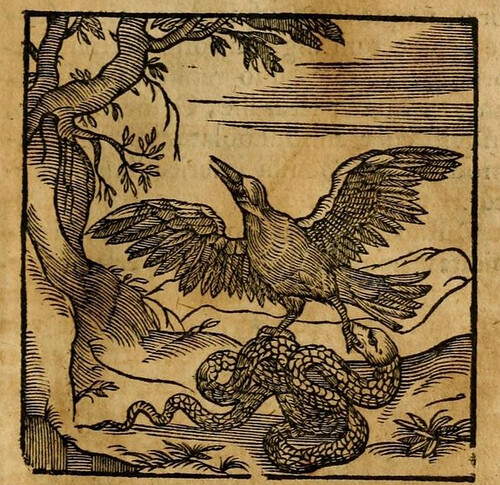
For an image today, here is that greedy kite: 621. Anguis et Milvus. Milvus raptum anguem, in altum volans, ferebat. At ille, repente conversus ipsumque morsu feriens, illico interfecit. Quapropter anguis morienti milvo aiebat, “Quid tam stultus fuisti ut eos laedere ac ad mortem rapere velles, qui nullam tibi iniuriam intulere? En ut merito eadem refers quae mihi facere parabas.” (source - easy version)

Corvus et Serpens

Monday, September 19, 2011

Round-Up: September 19

Here is a round-up of today's blog posts - and for previous posts, check out the Bestiaria Latina Blog archives. I'm using Google+ a lot these days - are there any of you I should look for there?

HODIE: ante diem tertium decimum Kalendas Octobres.

SCALA SAPIENTIAE: Today you can find sayings that go up to Diederich frequency ranking 64 - so the proverbs contain nothing but words found among the 64 most commonly used words in Latin. Here is one of the items in today's list: Quod vis videri, esto, "Be that which you wish to seem to be!"

ANECDOTE OF THE DAY: Today's anecdote is Gemini Filii, a story about the birth of Romulus and Remus.

VERBUM HODIERNUM: Today's NEW word is VIR - read a brief essay about the word at the Verbosum blog. Here's one of the sayings you can find in the essay: Qualis avis, talis cantus; qualis vir, talis oratio, "As the bird, so the song; as the man, so his speech."

VERBUM WIDGET: The word from the daily widget is AMOR - which also has a brief essay at the Verbosum blog. Here's one of the sayings you can find in that essay: Amor magister est optimus, "Love is the best teacher."

FABULAE FACILES: The NEW easy-to-read fable is Asinus Leoni Cantans, a funny little story about a self-confident donkey.

FABULAE FACILES WIDGET: The fable from the Fabulae Faciles widget is Mercurius, Homo, et Formicae , one of my favorite fables - the the story of a god, some ants, and a hypocritical human being.

MILLE FABULAE: ILLUSTRATIONS: The NEW fables with images are Avarus Agros Custodiens, a great fable about generosity and prosperity, and Avarus, Ignis Repertor, a story about the paradoxical and painful nature of greed.

MILLE FABULAE: ILLUSTRATIONS: The fable from the Mille Fabulae et Una widget is Membra et Venter, a story recorded by Livy made famous by its use by Shakespeare in Coriolanus.

GOOGLE BOOKS: Today's Google Books are Horapollinis Hieroglyphica Graece et Latine and L'Estrange's Fables of Aesop and Other Eminent Mythologists .

TODAY'S MOTTOES & PROVERBS: Widgets available at Schoolhouse Widgets.

3-Word Mottoes: Today's 3-word motto is Vulneror, non vincor (English: I am wounded, not defeated).

3-Word Proverbs: Today's 3-word proverb is Caritas omnia potest (English: Love can do all things).

Rhyming Proverbs: Today's proverb with rhyme is: Disce, quid es, quid eris: memor esto, quod morieris (English: Learn what you are, and what you will be: remember that you will die).

Vulgate Verse: Today's verse is Spiritus quidem promptus; caro vero infirma (Mark 14:38). For a translation, check out the polyglot Bible, in English, Hebrew, Latin and Greek, at the Sacred Texts Archive online.

Elizabethan Proverb Commentary: Here is today's proverb commentary, this time by Taverner: Veritas simplex oratio: Trouthes tale is simple, he that meaneth good faith, goeth not about to glose his communicacion with painted wordes. Plaine and homely men call a figge, a figge, and a spade a spade. Rhetorike and coloringe of spech, proved manye times a mans matter to be naught.

Today's image is for the famous fable of the belly and the members, 751. Membra et Venter. Membra quondam dicebant ventri, “Nosne te semper ministerio nostro alemus, dum tu summo otio frueris? Hoc non diutius faciemus.” Dum igitur ventri cibum subducunt, corpus debilitatum est, et membra sero invidiae suae paenituit. (source)

Membra et Venter