Saturday, May 14, 2011

Round-Up: May 14

Here is a round-up of today's blog posts - and for previous posts, check out the Bestiaria Latina Blog archives. You can keep up with the latest posts by using the RSS feed, or you might prefer to subscribe by email. I'm Twittering again now at Aesopus and AesopusEnglish.

HODIE: pridie Idus Maias (and yes, you can have your own Roman Google Calendar).

VERBUM HODIERNUM: Today's word is SIC - read a brief essay about the word at the Verbosum blog. Here's one of the sayings you can find in the essay: Sicut fecisti, fiet tibi, "As you have done, so it will be done to you."

BESTIARIA PROVERBS: There are some new animal proverbs today for PASSER, the sparrow, and VOLUCRES, birds. Here's a nice one: Ostendit nidus volucrem, quae fecerit ipsum, "The nest reveals which bird made it."

ANECDOTE OF THE DAY: Today's anecdote is Alexander at Canis Indus , a story about Alexander and the dogs he saw in India.

FABULAE FACILES: The new easy-to-read fable is Equus, Lupus, et Hordeum, a story about a horse and a hypocritical wolf.

MILLE FABULAE: FABLE OF THE DAY: The fable for today is Vulpecula et Tintinnabulum, the story of a fox who is fooled by the sound of a bell. (You can also a free PDF copy of the Mille Fabulae et Una book.)

MILLE FABULAE: ILLUSTRATIONS: The latest fables with images are Canis, Herus, et Cibus, a fable about a dog and his stingy master, and Draco Beneficii Memor, a story about a good-hearted dragon.

GOOGLE BOOKS: Today's Google Books are Allen & Fowler's Selections from Ovid and Goffaux's Robinson Crusoëus (a Latin translation of Defoe's Robinson Crusoe).

DISTICHA: Today's little poems are Ad veniam curras, ad vindictam pigriteris; / Ad pacem properes, ad iurgia non gradieris. (from Wegeler) and Plus vigila semper nec somno deditus esto; / Nam diuturna quies vitiis alimenta ministrat. (from Cato's distichs).

TODAY'S MOTTOES & PROVERBS: Widgets available at Schoolhouse Widgets.

Tiny Mottoes: Today's tiny motto is: Veritas vincit (English: Truth triumphs).

3-Word Proverbs Verb-less: Today's 3-word verb-less proverb is Deo nihil impossibile (English: For God, nothing is impossible)

Audio Latin Proverb: Today's audio Latin proverb is Felix alterius cui sunt documenta flagella (English: Happy is the man for whom another man's lashings are a lesson). To read a brief essay about this proverb and to listen to the audio, visit the Latin Via Proverbs blog.

Maxims of Publilius Syrus: Today's proverb from Publilius Syrus is: Contra hostem aut fortem oportet esse aut supplicem (English: Against your enemy you must be either bold or humble).

Animal Proverb from Erasmus: Today's animal proverb from Erasmus is Locrensis bos (English: A Locrian ox; from Adagia 2.8.62 - this refers to a cheap substitution: when the gods expected a sacrificial ox, the Locrians made a tiny ox of wood and sacrificed that instead).

For an image today, here is Robinson Crusoe, a.k.a. Robinson Crusoëus:


Here's the book at Google Books:

Saturday, May 7, 2011

Hiatus Aestivus I

I'm going to be out of town for a week, so here are the daily stories and proverbs for while I'll be gone; they won't come through in the email, but just check the blog post to see what's new for the day... automatically updated while I am gone, thanks to the magic of javascript!


Round-Up: May 7

Here is a round-up of today's blog posts - and for previous posts, check out the Bestiaria Latina Blog archives. You can keep up with the latest posts by using the RSS feed, or you might prefer to subscribe by email. I'm Twittering again now at Aesopus and AesopusEnglish.

HODIE: Nonae Maiae, the Nones of May (and yes, you can have your own Roman Google Calendar).

VERBUM HODIERNUM: Today's word is FIO - read a brief essay about the word at the Verbosum blog. Here's one of the sayings you can find in the essay: Quod tibi vis fieri, fac alteri, "What you want to be done to you, do you to another."

BESTIARIA PROVERBS: There are some new animal proverbs today for APES, the bee, and MILVUS, the kite. Here's a nice one: Rete ne tendas accipitri et milvo, "Don't try to catch a hawk or a kite with a bird net."

ANECDOTE OF THE DAY: Today's anecdote is Sertorius et Cerva Eius, the story of Sertorius and his supernatural white deer.

FABULAE FACILES: The new easy-to-read fable is Ranae Duae et Puteus, the story of two frogs - one who is reckless, and one who is cautious.

MILLE FABULAE: FABLE OF THE DAY: The fable for today is Asinus et Canis, a fable about the different tastes of a dog and a donkey. (You can also a free PDF copy of the Mille Fabulae et Una book.)

MILLE FABULAE: ILLUSTRATIONS: The latest fables with images are Rusticus et Torrens, the story of how still waters run deep, and Viator et Lapides, the story of a traveler who confronts a stony path.

GOOGLE BOOKS: Today's Google Books are Harkness's Preparatory Course in Latin Prose Authors and Allen & Greenough's edition of Cicero's Senectute & de Amicitia.

DISTICHA: Today's little poems are Quamvis dura, tamen caprificus marmora findit. / Contemnas hostem, si sapis, ipse cave. (from Camerarius) and Frangere vi mavis, quam lente flectere ramum? / Est tractare homines molliter artis opus. (also from Camerarius).

TODAY'S MOTTOES & PROVERBS: Widgets available at Schoolhouse Widgets.

3-Word Mottoes: Today's 3-word motto is Ne cede malis (English: Yield not to evils).

3-Word Proverbs: Today's 3-word proverb is Sol omnibus lucet (English: The sun shines on everyone).

Rhyming Proverbs: Today's proverb with rhyme is: Saepe ferox iuvenem mors rapit ante senem (English: Cruel death often snatches the young man before the old).

Vulgate Verse: Today's verse is Dimitte mortuos sepelire mortuos suos (Matt. 8:22). For a translation, check out the polyglot Bible, in English, Hebrew, Latin and Greek, at the Sacred Texts Archive online.

Elizabethan Proverb Commentary: Here is today's proverb commentary, this time by Taverner: Amicus certus in re incerta cernitur: A friend certain is espied in a thing incertaine, that is to say, in adversitie, where a mans matters are inconstant, doubtfull, and full of daunger. And therfore yf thou will do wel, do as the english proverbe biddeth the. Prove thy friend, ere thou have nede.

For an image today, here is Camerarius's emblem to go with the distich about the wild fig tree which shows that even if you are hard as rock you should beware of potential enemies: Quamvis dura, tamen caprificus marmora findit. / Contemnas hostem, si sapis, ipse cave.

Thursday, May 5, 2011

Round-Up: May 5

Here is a round-up of today's blog posts - and for previous posts, check out the Bestiaria Latina Blog archives. You can keep up with the latest posts by using the RSS feed, or you might prefer to subscribe by email. I'm Twittering again now at Aesopus and AesopusEnglish.

HODIE: ante diem tertium Nonas Maias (and yes, you can have your own Roman Google Calendar).

VERBUM HODIERNUM: Today's word is SOLEO - read a brief essay about the word at the Verbosum blog. Here's one of the sayings you can find in the essay: Non solet esse incruenta victoria, "Victory does not usually come without bloodshed."

BESTIARIA PROVERBS: There are some new animal proverbs today for ANGUILLA , the eel, and AVIS, the bird. Here's a nice one: Avis matutina vermem capit, "The early bird catches the worm."

ANECDOTE OF THE DAY: Today's anecdote is Aristoteles et Successor Eius, a story about how Theophrastus was chosen as Aristotle's successor.

FABULAE FACILES: The new easy-to-read fable is Monachi et Abbates, a funny story about things going from bad to worse at a monastery.

MILLE FABULAE: FABLE OF THE DAY: The fable for today is Dives et Thesaurus Eius, an ingenious little story about the trickster tricked. (You can also a free PDF copy of the Mille Fabulae et Una book.)

MILLE FABULAE: ILLUSTRATIONS: The latest fables with images are Abbas et Iuvenis, a great wisdom tale from the world of the monks, and Heremita et Mus, a sly story about a hermit and his mouse.

GOOGLE BOOKS: I've finished writing up the books with macrons that I've found at GoogleBooks, which you can see listed here.

DISTICHA: Today's little poems are Umbram, non fructum Platanus dat; sic quoque multis / Vana alios specie ludere saepe placet. (from Camerarius) and Ad tua cur taceam dicteria foeda requiris? / Non anagyrin ego, spurce, movere volo. (also from Camerarius).

TODAY'S MOTTOES & PROVERBS: Widgets available at Schoolhouse Widgets.

Tiny Proverbs: Today's tiny proverb is: Omnia transibunt (English: All things will pass).

3-Word Mottoes Verb-less: Today's 3-word verb-less motto is Vigilantibus, non dormientibus (English: For those who watch, not those who sleep).

Latin Animal Proverb: Today's animal proverb is Unus lanius non timet multas oves (English: One butcher does not fear many sheep).

Proverbs of Polydorus: Today's proverb from Polydorus is: Vae terrae, cuius rex puer est (English: Woe to the land whose king is a boy).

Proper Name Proverb from Erasmus: Today's proper name proverb from Erasmus is Iliensis tragoedos conduxit (English: The man from Troy has hired some tragic actors; from Adagia 2.4.35; this refers to someone who wishes to renew the sad events of his past, like a Trojan who wants to see a tragedy about the fall of Troy).

Greek Proverb of the Day: Today's proverb is Ὅστις δὶς ναυαγήσει μάτην μέμφεται Ποσειδῶνα (English: The man who is shipwrecked a second time blames Poseidon in vain).

Here's an image to go with that Poseidon proverb! The statue is located in Virginia Beach, where they hold an annual Neptune Festival. You can find many more views of this wonderful statue with this Google Image Search; this image was taken by Neal Rattican:

Wednesday, May 4, 2011

Round-Up: May 4

Here is a round-up of today's blog posts - and for previous posts, check out the Bestiaria Latina Blog archives. You can keep up with the latest posts by using the RSS feed, or you might prefer to subscribe by email. I'm Twittering again now at Aesopus and AesopusEnglish.

HODIE: ante diem quartum Nonas Maias (and yes, you can have your own Roman Google Calendar).

VERBUM HODIERNUM: Today's word is TUNC - read a brief essay about the word at the Verbosum blog. Here's one of the sayings you can find in the essay: Tunc alios culpa, cum tu sis sine culpa, "You can blame others when you yourself are blameless."

BESTIARIA PROVERBS: There are some new animal proverbs today for HIRUNDO, the swallow, and BOS, the ox. Here's a nice one: Optat ephippia bos piger, optat arare caballus, "The lazy ox wants fancy horse trappings, and the horse wants to plow the field."

ANECDOTE OF THE DAY: Today's anecdote is Mausolus, the story of Artemisia, her husband Mausolus and the first mausoleum.

FABULAE FACILES: The new easy-to-read fable is Vulpes et Mulieres, what happened when the fox saw some women eating roast chickens.

MILLE FABULAE: FABLE OF THE DAY: The fable for today is Asinus et Viatores Duo, the story of two men fighting over a stray donkey. (You can also a free PDF copy of the Mille Fabulae et Una book.)

MILLE FABULAE: ILLUSTRATIONS: The latest fables with images are Serapis et Parricida, a great fable about the god Serapis, and Fur et Stultus, a funny little story about a quick-witted thief.

GOOGLE BOOKS: Today's Google Books are Harkness's Sallust - Catiline and Gardner's Selection from Latin Classic Authors .

DISTICHA: Today's little poems are Multorum cum facta senex et dicta recenses, / Fac tibi succurrant, iuvenis quae feceris ipse. (from Cato) and Consilio moderato animos frenato furentes, / Ut rigidas quercus vimina lenta solent. (from Camerarius).

TODAY'S MOTTOES & PROVERBS: Widgets available at Schoolhouse Widgets.

Tiny Mottoes: Today's tiny motto is: Memor (English: Mindful).

3-Word Proverbs Verb-less: Today's 3-word verb-less proverb is Tempus edax rerum (English: Time is the eater of things)

Audio Latin Proverb: Today's audio Latin proverb is Echinus partum differt (English: The hedgehog postpones its giving birth). To read a brief essay about this proverb and to listen to the audio, visit the Latin Via Proverbs blog.

Maxims of Publilius Syrus: Today's proverb from Publilius Syrus is: Nulla hominum maior poena est quam infelicitas (English: There is no great punishment for people than unhappiness).

Animal Proverb from Erasmus: Today's animal proverb from Erasmus is Bos lassus fortius figit pedem (English: The ox, when tired, fixes his hoof more firmly; from Adagia 1.1.47).

For an image today, here is the god Serapis and a story about how he vindicates the power of divine justice, 801. Serapis et Parricida. Decubuerat ad ruinosum parietem quidam facinoribus parricidii pollutus, ut ibi somnum caperet. Huic oblatus per quietem Serapis, monuit eum ut fugeret atque discederet et alibi obdormisceret. Paruit ille et surrexit atque abiit, cum statim paries ille corruit. Mane gratias agens hic diis ob conservatam ab ipsis vitam suam cum gaudio rem divinam fecit, quasi parricidae numini divino cari essent. Rursum autem Serapis dormienti suam speciem ostendit et “Censesne tu,” inquit, “sceleste, mihi curae esse improbos atque malos? Immo si tu nunc isto pacto obiisses mortem, fuisset ea singularis doloris et infamiae expers. Quam ideo nunc effugisti, quia servaris crucis merito supplicio.” (source)

Sunday, May 1, 2011

Round-Up: May 1

Here is a round-up of today's blog posts - and for previous posts, check out the Bestiaria Latina Blog archives. You can keep up with the latest posts by using the RSS feed, or you might prefer to subscribe by email. I'm Twittering again now at Aesopus and AesopusEnglish.

HODIE: Kalendae Maiae, the Kalends of May (and yes, you can have your own Roman Google Calendar).

VERBUM HODIERNUM: Today's word is VIS - read a brief essay about the word at the Verbosum blog. Here's one of the sayings you can find in the essay: Plura consilio quam vi perficimus, "We can accomplish more things by planning than by force."

BESTIARIA PROVERBS: There are some new animal proverbs today for ALAUDA, the crested lark, and LEO, the lion. Here's a nice one: Ne capra contra leonem, "The nanny-goat should not [fight] against the lion."

ANECDOTE OF THE DAY: Today's anecdote is Teanum Sidicinum, a funny little story about a Roman woman who wanted to bathe in the men's baths.

FABULAE FACILES: The new easy-to-read fable is Navigantes in Eadem Navi Inimici, a fable about undying enmity!

MILLE FABULAE: FABLE OF THE DAY: The fable for today is Ranae Duae Vicinae, a story about two frogs, one wise, and one foolish. (You can also a free PDF copy of the Mille Fabulae et Una book.)

MILLE FABULAE: ILLUSTRATIONS: The latest fables with images are Coclea et Gallus, a story about a persistent little snail, and Erucae Duae, a story about a very self-important butterfly.

GOOGLE BOOKS: Today's Google Books are Allen's Select Orations of Cicero and White's Fables of Phaedrus .

DISTICHA: Today's little poems are Festinare nocet, nocet et cunctatio saepe: / Tempore quaeque suo qui facit, ille sapit. (from Camerarius) and Cautus homo est, et Acerrus habet quot lumina quondam / Argus, at haec dubie cuncta nihilve vident. (from Campion).

TODAY'S MOTTOES & PROVERBS: Widgets available at Schoolhouse Widgets.

3-Word Mottoes: Today's 3-word motto is Non nobis nascimur (English: We are not born for ourselves alone).

3-Word Proverbs: Today's 3-word proverb is Necessitati parendum est (English: Necessity must be obeyed).

Rhyming Proverbs: Today's proverb with rhyme is: Parcito saepe cibis, et sic annosior ibis (English: Be sparing often with your food, and thus will go on to live a longer life).

Vulgate Verse: Today's verse is Qui seminat iniquitatem, metet mala (Proverbs 22:8). For a translation, check out the polyglot Bible, in English, Hebrew, Latin and Greek, at the Sacred Texts Archive online.

Elizabethan Proverb Commentary: Here is today's proverb commentary, this time by Taverner: Omnia idem pulvis: Al is one self dust or asshes. From earth wee came, and to earth wee shall. Yea the scripture saith that asshes wee be, and to asshes we shall reverte. Nowe amongest asshes or dust I pray you, what greate difference is ther? How will ye discerne the asshes of a Kinge, or an Emperour, of a Duke, of a great Bishop, from the asshes of a cobler, yea of a begger..

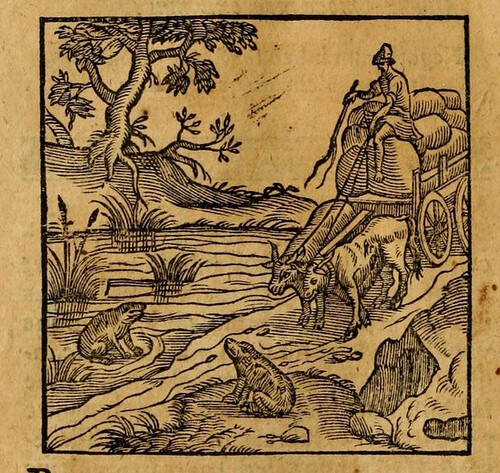
Today's image is for the story of the two frogs, 610. Ranae Duae Vicinae. Ranae duae vicina loca incolebant, altera paludem profundam, altera lacunulam iuxta viam in qua modicum aquae substiterat. Tum illa paludis inhabitatrix hortabatur alteram ad se ut commigraret, ubi multo tutiorem vitam degere liceret. Haec vero negabat se posse avelli a consueto domicilio atque loco. Paulo post, eam nihil metuentem plaustri rotae contriverunt (source).

Ranae Duae Vicinae